
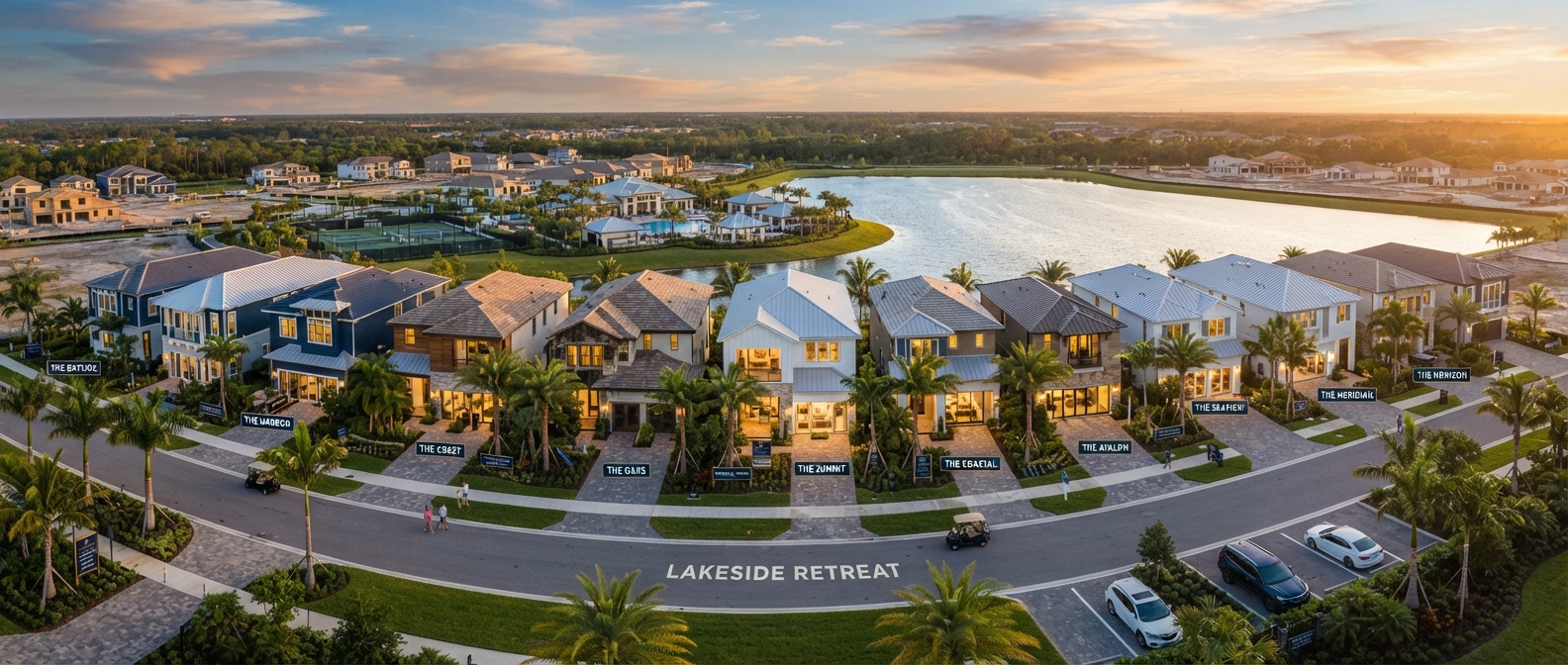
Editorial cinematic aerial Florida new construction model row at golden hour with palm trees in navy and gold tones
Tampa Bay · New Construction

Builder incentives, explained.

Rate buy-downs, closing-cost credits, design-center packages, lot waivers. What the headline figure actually pays back, what the contract still requires, and the hold-period math that decides whether the deal is real.

  • South Tampa
  • Wesley Chapel
  • Downtown Tampa
  • St. Petersburg
  • Clearwater Beach
  • Tierra Verde
  • Davis Islands
  • Hyde Park
  • Westchase
  • Channelside
  • South Tampa
  • Wesley Chapel
  • Downtown Tampa
  • St. Petersburg
  • Clearwater Beach
  • Tierra Verde
  • Davis Islands
  • Hyde Park
  • Westchase
  • Channelside
The Four Structures

Every Tampa Bay builder incentive, in four boxes.

Not all builder incentives carry the same weight. The structure of the offer — rate, cash, credit, or upgrade — determines what the headline figure actually pays back over the life of the loan.

Most Impactful · 2026 Cycle

Rate buy-downs.

The builder pays a lump sum at closing to permanently or temporarily lower your mortgage rate. A 2-1 temporary buydown cuts the note rate 2% in year one and 1% in year two before reverting to the full rate — useful if you expect to refinance. A permanent buydown locks the savings across the full loan term. Almost every builder requires their own preferred lender, so a side-by-side Loan Estimate comparison is non-negotiable.

High-Leverage · Closing

Closing-cost credit.

A fixed dollar amount the builder credits at closing, typically $5,000 to $25,000 depending on community and phase. The credit lowers your cash to close, not your financed loan amount — meaning the headline number doesn't reduce your principal or your monthly payment. Some builders cap how much of the credit can absorb into closing costs and re-route the excess to a rate buydown or forfeit it entirely. Worth chasing hardest on QMI inventory and the final 10–15 homes of a phase closeout.

To-Be-Built · Design Studio

Design credit.

A dollar amount applied toward premium finishes, structural options, and design-center upgrades. Most valuable on to-be-built homes where you control selections — cabinetry, flooring, countertops, extended lanai, additional bedrooms. Design-center markups typically run 30–50% above retail, so a $20,000 credit at the design studio may only represent $10,000–$13,000 of actual material value. Experienced agents know which builders' design studios carry the least markup.

Phase Closeout · QMI

Free upgrades & lot waivers.

Premium lots — water, conservation, corners — carry $5,000–$60,000 surcharges that builders may fully waive during closeout windows or slow seasonal periods. Because a lot premium waiver reduces the base price, it reduces your financed amount — not just your closing number. Free appliance packages, smart-home bundles, and extended warranty coverage fall into this category. Conversion to cash is often negotiable but rarely offered unsolicited.

The Hold-Period Math

How long are you actually holding?

A $20,000 incentive looks the same on a flyer whether you hold the home for 18 months or 10 years. It isn't. The actual value of any incentive is a function of how long you keep the loan — the cost savings of a rate buy-down only materialize across the months you actually pay on the financed amount, and a closing-cost credit vanishes entirely if you refinance within the first year.

Most Tampa Bay new construction buyers underwrite the incentive as a single number at the closing table. The honest framing is a hold-period model. A 2-1 rate buydown on a $425,000 loan saves roughly $500 per month in year one and $250 per month in year two, then disappears — so a buyer planning to refinance before month 24 captures most of the value, while a buyer planning to hold a decade captures none of it. Permanent buydowns, lot-premium waivers, and design credit on selections you'd actually make are the three incentive structures that survive a 7- to 10-year hold.

Side by Side

Three Tampa Bay markets, three incentive regimes.

Comparing active incentives only — without reading the hold-period math against each community — mis-prices most new construction purchases.

CommunityActive IncentivesReal Effective Price5-Year Hold Cost vs. Discount
Two Rivers · Wesley Chapel2-1 buydowns · $10K–$25K closing credit · lot waivers on phase closeoutsList price within 1–2% of true market; net cost ~3–5% below flyer after creditsBest for movers: temporary buydown + closing credit deliver the full value inside 24 months
Pasadena Hills · Land O' LakesPermanent rate buydowns on QMI · $15K design credit · preferred-lender flex cashSlightly higher base price; aggressive credits compress effective price 5–8%Best for long-holders: permanent buydowns carry full value across a 10-year term
Boutique tower · South TampaLimited rate buydowns · closing-cost credits capped at $10K · pre-build design creditsBase pricing premium of 8–12%; incentives rarely close the resale gapWorst hold math: incentives front-loaded into year one, phasing out where resale leverage is the only real return
Market Signals

When incentives are real signals.

Three market conditions where the headline incentive package is actually a structural read on the Tampa Bay new construction segment — not a one-off concession.

Inventory Normalizing

Inventory is normalizing, not collapsing.

When months-of-supply starts to compress in a seller's market, builder incentives follow. Builders don't cut prices; they cut through the contract with credits. A community moving from 7.2 to 4.6 months of supply over a single quarter is a real signal that the headline incentive structure is structurally tightening, not a one-off concession.

Phase Closeout Windows

Watch the phase closeout window.

The final 10–15 homes of a phase routinely carry $5,000–$15,000 more in incentive value than the same model at phase start. Builders need the capital out, the appraisals to clear on the next phase, and the next release to launch clean. An agent actively tracking build phases is the only reliable way to catch these windows — they are never publicly announced.

Concessions vs. Cuts

Concessions widen even as base prices hold.

Across Wesley Chapel and Pasco in Q1 2026, base prices are flat-to-up and concessions are expanding. That's the textbook incentive regime: builders refuse to print a new low comp, so the same dollar of value moves through closing-cost credit, rate buy-down bundling, and lot-premium waiver. Reading the base price without reading the concession is misreading the market.

Common Questions

FAQ.

The questions buyers ask me most often about Tampa Bay builder incentives — answered the way I'd answer them in the model home.

Are builder incentives really worth chasing in 2026?

Yes — but the value is concentrated in the right structures. In Tampa Bay Q1 2026, the highest-impact incentives are 2-1 temporary rate buydowns on closing windows under 90 days, closing-cost credits on QMI inventory, and lot-premium waivers during phase closeouts. Design-credit packages are noticeably weaker in real value than their headline number suggests, and free appliance bundles are commonly a builder-margin item dressed up as a buyer benefit.

Do I have to use the builder's preferred lender to get the incentive?

Almost always for the headline package. Most builders condition the rate buydown and the largest closing-cost credit on the buyer financing through the builder's captive or preferred mortgage company. The independent analysis — preferred lender Loan Estimate vs. outside lender Loan Estimate with the incentive forfeited — is the highest-value 30 minutes of the entire purchase and the step most buyers skip without representation.

Is it free to bring a Realtor on a new construction purchase?

Yes — the builder pays the buyer's agent commission in full. Cost to the buyer is zero. The independent review you receive in return — contract framing, lender comparison, design-center strategy, pre-drywall inspection, and phase-closeout timing — is the difference between capturing the headline incentive and capturing the real-value incentive. Going unrepresented is leaving that distinction on the table at no offsetting savings.

Independent Analysis

Run your incentive before you sign.

Independent review of any Tampa Bay builder incentive package before you commit — preferred lender Loan Estimate vs. outside lender, design-center markup analysis, contract framing, and hold-period modeling. The 30 minutes before signing is the highest-value 30 minutes of the entire purchase.

Representation on a new construction purchase costs the buyer nothing — the builder pays the buyer's agent commission in full.