
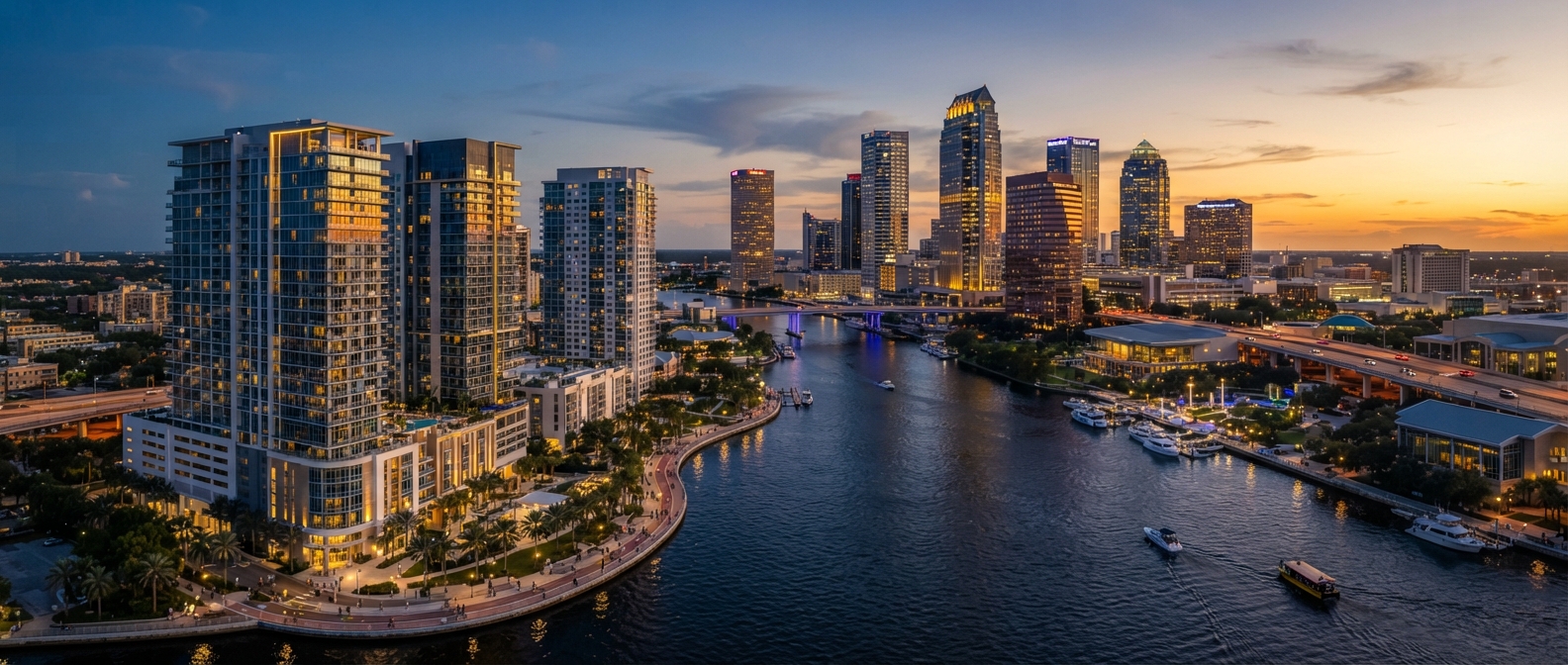
Aerial golden-hour view of downtown Tampa, the Riverwalk, and the waterfront condo corridor
Tampa Bay · Buyer's Guide 2026

Downtown Tampa condo buyer checklist.

What every buyer should verify before signing a contract on a downtown tower unit — HOA health, deed-restricted parking, wind and flood insurance, rental policy, assessments, and the items only a building attorney will pull.

  • South Tampa
  • Wesley Chapel
  • Downtown Tampa
  • St. Petersburg
  • Clearwater Beach
  • Tierra Verde
  • Davis Islands
  • Hyde Park
  • Westchase
  • Channelside
  • South Tampa
  • Wesley Chapel
  • Downtown Tampa
  • St. Petersburg
  • Clearwater Beach
  • Tierra Verde
  • Davis Islands
  • Hyde Park
  • Westchase
  • Channelside
Quick Facts

What you're checking.

Seven sections, twenty-six verifications. The shortest route from contract to confidence on a downtown Tampa condo.

Focus
Downtown Tampa high-rise
Decision window
14–45 days
Top exposure
Special assessments
Top mitigation
Reserve funding + minutes
Insurance variable
Wind + flood elevation
Closing reading
Declarations + estoppel
The Checklist

Seven sections.
One signed contract.

Walk It With Rob →
Verifications4

HOA health & reserves

  • 01 · Pull the last two years of HOA financials.

    Look at operating surplus, reserve funding percentage, and any deficit spending. A reserve under 50% funded is a red flag.

  • 02 · Read the reserve study in full.

    Identify which capital items are scheduled in the next five years — roof, elevators, seawall, facade — and whether current dues cover them.

  • 03 · Confirm the fee trajectory.

    Ask for the last three years of increases and the proposed budget for the upcoming fiscal year. Downtown fees have moved in lumps.

  • 04 · Check the management company's standing.

    A turn-over of property managers in the last 24 months usually points to a board-level dispute that will resurface in your ownership.

Unit-Specific4

Floor plan + deed-restricted parking

  • 01 · Verify deed-restricted parking and storage.

    Confirm which spaces are appurtenant to the unit (deed-restricted) versus which are assigned by license. Only deed-restricted spaces transfer at sale.

  • 02 · Confirm the floor plan matches the public record.

    Pull the unit's recorded square footage from the county appraiser and reconcile against the listing. Errors of 30–80 sqft are common in downtown inventory.

  • 03 · Inspect balcony, mechanical chase, and HVAC closet.

    These are unit-owner responsibilities under most downtown bylaws and are excluded from the building envelope.

  • 04 · Verify pet and vehicle restrictions.

    Two pets, size, breed, and weight clauses vary widely in downtown buildings. Confirm before you measure the couch.

Risk4

Insurance / wind / flood

  • 01 · Get a wind + flood insurance quote before contract.

    Do not rely on the seller's current premium. Wind coverage in Hillsborough and Pinellas runs on elevation, construction, and distance to coast.

  • 02 · Confirm the building's master policy status.

    A master policy shortfall flows back to owners as a special assessment after a named storm. Review the deductible and adjusters used.

  • 03 · Verify the building's flood zone and elevation certificate.

    An older or missing elevation certificate can move a unit out of a preferred-risk flood policy and into a four-figure premium bracket.

  • 04 · Check hurricane mitigation credits.

    Impact glass, strap and shutter certification, and roof-to-wall attachments change wind premiums meaningfully. Track them on every downtown tour.

Policy3

Rental policy

  • 01 · Read the leasing cap and minimum-lease clause.

    Some downtown buildings cap rentals at 30–50% of total units. A cap that has been reached freezes your rental exit.

  • 02 · Confirm the approval process and transfer fee.

    Tenant applications, interview fees, and lease transfer charges add to the cost of exit and to the cost of carrying the unit.

  • 03 · Identify seasonal and short-stay restrictions.

    Airbnb-style short stays are typically disallowed in downtown Tampa. Confirm any monthly minimum before buying as an income-property candidate.

Capital Exposure3

Special assessments

  • 01 · Pull the agenda and minutes from the last 12 months.

    Pending assessments surface in minutes 3–6 months before billing. Look for envelope work, cooling-tower replacement, and garage restoration.

  • 02 · Ask whether any litigation is active.

    Construction-defect cases, contractor disputes, or insurance recovery actions materially affect reserve trajectory and resale optics.

  • 03 · Count any unpaid assessments on the unit.

    Unpaid assessments transfer to the new owner on most condo bylaws. Reconcile the title commitment against the management ledger.

Resale3

Resale comps rule

  • 01 · Comp within the same building, same line, last 6 months.

    If there are no in-building comps, the appraiser will reach outside the building and the price will compress.

  • 02 · Match floor and view corridor.

    A low-floor comp is not a high-floor comparable — view and stack position can drive a 12–18% delta in resale value.

  • 03 · Check the listing-to-close ratio for the building.

    If listings expire or reduce twice before going pending, the building has a price-discovery problem that reappears on resale.

Your Team3

What the building attorney should review

  • 01 · Declaration of condominium and all amendments.

    Amendments can change parking, pet policy, and rental rights. The attorney reads all of them, not just the asserted summary.

  • 02 · Bylaws, board meeting minutes (24 months), and budget.

    A condo closing without 24 months of minutes is an underwritten exposure. The attorney should receive them before signing.

  • 03 · Estoppel certificate and current assessment status.

    The estoppel binds the association on what is owed, what is in process, and what the buyer is taking on.

Why a checklist matters

The building is half the decision.

In a single-family or townhome transaction, the home is the decision. In a downtown Tampa condo, the building carries at least half of it — sometimes more. Two units of identical square footage on adjacent floors can produce very different three-year outcomes depending on reserve funding, master insurance shortfall, the upcoming capital calendar, and the board's appetite for special assessments.

A checklist is the difference between buying a unit and buying into a building. The page above is the version I run with every downtown buyer before contract — every line is one a building attorney, an association manager, or a forensic underwriter has flagged in the last twenty-four months.

Pre-construction buyers — including allocation buyers positioning into Pendry Residences and similar downtown towers — should review a parallel checklist tailored to pre-construction release terms. The working framework for those buyers runs through the Tampa Luxury Real Estate Agent page and the SERHANT. priority list.

Floor-plan pitfalls

Parking, storage, and the lines on the page.

The most common downtown floor-plan mistake is mistaking a licensed parking space for a deed-restricted one. Only deed-restricted parking transfers at sale — usable, financed, and counted as part of the unit. A licensed space is a revocable privilege that can be re-assigned, removed, or re-priced by the next board.

The second is the recorded square footage. Listings often carry the developer's marketing sheet, which can include balcony, garage, or common-area measurements that the county appraiser does not. Pull the appraiser's page before pricing and reconcile against the floor-plan dimension on the recorded exhibit.

The third is pet and vehicle policy, which sounds cosmetic but is structural to a downtown lifestyle. Two pets of 60 lbs is not the same policy envelope as one pet under 25 lbs — and a building that disallows pickup trucks or commercial vehicles will quietly affect your daily use of the unit.

Insurance reality check

Wind, flood, and what the master policy misses.

Downtown Tampa insurance is three separate policies in a trench coat: the HOA master policy (which covers the building envelope but rarely the interior finishes), the HO-3 homeowner policy (which carries your personal property and unit improvements), and the wind + flood policy, which moves entirely on elevation, distance to coast, and construction class.

Pull an elevation certificate. Pull a written wind quote from a Florida admitted carrier. Verify the master policy deductible and the percentage the association carries. A $25,000 master deductible flows to owners as a special assessment after a single named storm — that fact alone can change your offer.

Mitigation credits are the only controllable knob in this stack. Impact glass, strap-and-shutter certification, and roof-to-wall attachments translate into measurable wind premium reductions and are worth confirming during the inspection window.

FAQ

Questions a downtown buyer asks first.

The four questions buyers surface in the first consult, with the answers I run in practice.

Why does a downtown condo need its own checklist?
In a single-family or townhome, the home is the decision. In a downtown condo, the building is at least half the decision. Reserves, assessments, bylaws, master insurance, and rental policy determine both your monthly carry and your three-year exit. A buyer-friendly checklist pressures all of those before you sign.
Which item on this list is most often skipped?
Most buyers pull the budget and skip 24 months of board minutes. That is precisely where unannounced assessment work surfaces. Skipping minutes is the most expensive line on the list.
Do I need a condo-specific attorney for closing?
Yes. The estoppel certificate, the declarations, and the bylaws each carry specific condo law interpretations that a residential-only closing attorney will not pressure. Tampa Bay condo defaults are usually small enough that a specialist should be in the deal.
How does this checklist interact with builder pre-construction?
It does not — pre-construction has its own due diligence set. This checklist is for resale inventory in the existing downtown tower stock. If you are evaluating a building like Pendry Residences or any pre-construction allocation, the conversation runs through the SERHANT. priority list, not resale HOA review.
Buyer's Strategy

Walk the checklist with Rob.

Robert O'Connor and Patriot Home Group by SERHANT. represent downtown buyers across the existing tower stock and the pre-construction release window. A 30-minute consult covers carry-cost reality, the building you're walking, and the assessment exposure you haven't been shown yet.

robert.oconnor@serhant.comFounding Member · SERHANT. Florida