
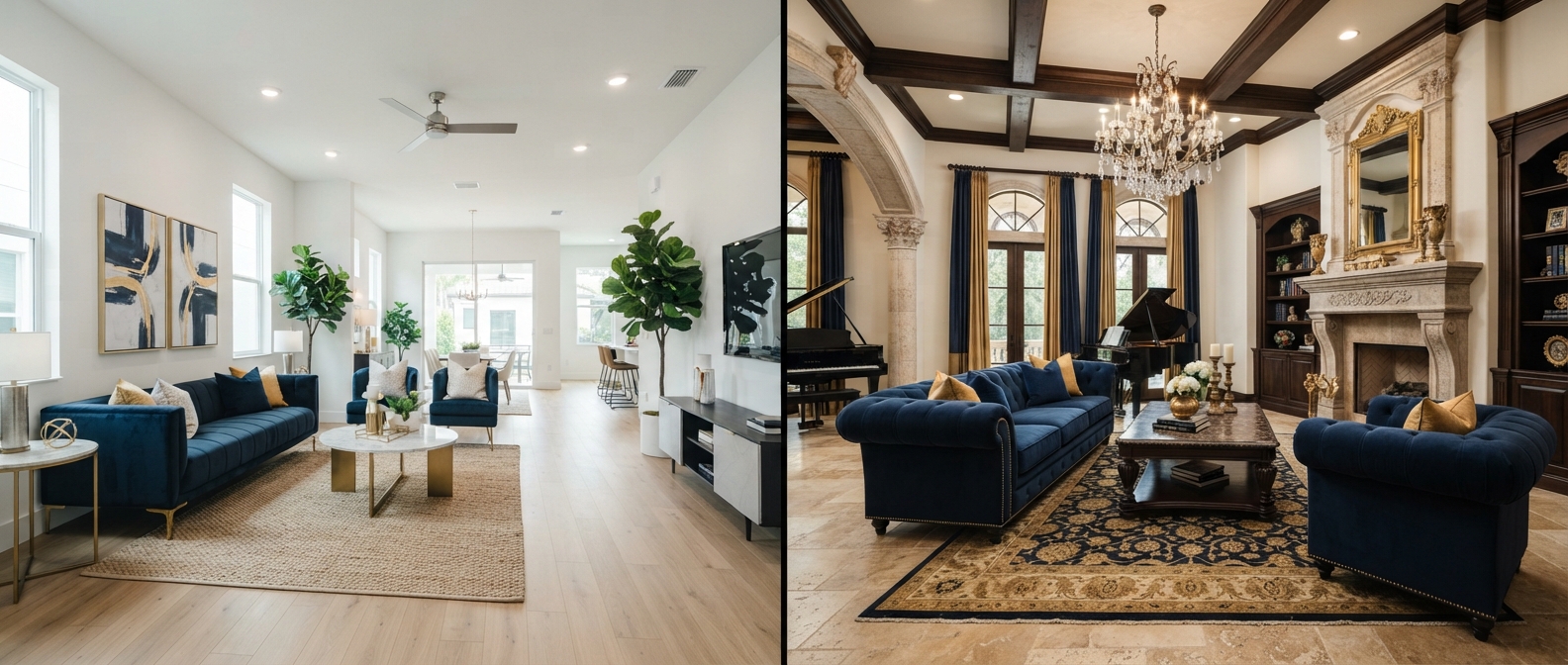
New construction vs resale:
a Tampa Bay comparison.
An editorial 2026 buyer's comparison of new construction and resale across Tampa Bay — price per square foot, build warranty, customization, closing timeline, HOA/CDD, insurance, resale liquidity, and hold horizon — written so the math, not the headline, decides which side wins for your goals.
- South Tampa✦
- Wesley Chapel✦
- Downtown Tampa✦
- St. Petersburg✦
- Clearwater Beach✦
- Tierra Verde✦
- Davis Islands✦
- Hyde Park✦
- Westchase✦
- Channelside✦
- South Tampa✦
- Wesley Chapel✦
- Downtown Tampa✦
- St. Petersburg✦
- Clearwater Beach✦
- Tierra Verde✦
- Davis Islands✦
- Hyde Park✦
- Westchase✦
- Channelside✦
Side by side,
Tampa Bay.
The 2026 Tampa Bay compare-contrast table — eight dimensions that actually move the decision, from price per square foot and warranty scope to HOA/CDD, insurance, and the hold horizon. Read it as a side-by-side, not as a verdict.
| Dimension | What Tampa Bay buyers see |
|---|---|
| Price per square foot | New construction in master-planned communities typically carries a 10–20% PSF premium for the same square footage; resale in established South Tampa and Snell Isle pockets can trade below replacement cost when the seller is motivated. |
| Build warranty | New construction writes a 1-year builder warranty and a 10-year structural warranty against resale's 'as-is' status, which compresses the first-year repair budget and improves insurance claim leverage. |
| Customization | New construction runs through the design center for structural and finish upgrades before the framing closes, while resale customization is post-purchase and infrequently includes load-bearing change. |
| Closing timeline | Resale closes in 30–45 days from contract; new construction pre-construction allocations close in 60–120 days; new construction at-frame closings average 6–18 months from contract to keys. |
| HOA / CDD fees | New construction master-plans in Wesley Chapel and Pasco County typically carry higher combined HOA + CDD assessments ($300–$700/month) than established South Tampa resale, and the CDD obligation survives resale. |
| Insurance | New construction under modern Florida building codes (post-Hurricane Ian impact-rated roof deck, hurricane straps, impact glass) generally prices wind coverage 10–25% below a same-square-footage resale of vintage 1995–2008. |
| Resale liquidity | Resale draws on a deep Tampa Bay comp set and a 90-year inventory history; new construction's first resale wave depends on the project's lease-up, the developer's remaining inventory, and HOA reserve strength. |
| Hold horizon | Resale rewards 3–7 year holds with stable appreciation against proven comps; new construction rewards 0–3 year holds when builder incentives and pre-construction pricing absorb appreciation. |
Reading reflects active 2026 broker pre-construction packages, builder incentive sheets, and a rolling comp set across South Tampa, Wesley Chapel, Downtown Tampa, and the Pinellas waterfront influence radius.
Three buyer profiles,
the builder-warranty edge.
Buyer-side conditions where the new construction math wins against the Tampa Bay resale comp set — the design-center customization, the 7–10 year code hold, and the warranty stack over monthly carry.
Customization-first buyer
A buyer who wants the design-center package locked in before framing closes — elevation, structural, electrical, and finish — runs a structurally cheaper new-build path than a post-purchase remodel on a same-vintage resale.
7–10 year hold buyer
Code compliance becomes a resale asset at the 7–10 year mark. Buyers holding through the new-construction warranty window exit into a market that pays a premium for modern roof deck attachment, hurricane straps, and impact-rated glass.
Warranty-over-monthly buyer
Buyer who underwrites on first-year operating cost — repair budget, appliance spend, HVAC reserve — layers the 1-year builder warranty and the 10-year structural warranty on top of insurance and lands on a tighter five-year cost picture than resale.
Three buyer profiles,
the closing-speed edge.
Buyer-side conditions where the Tampa Bay resale comp set wins against new construction — the close-this-quarter acceleration, the treed-lot and elevation confidence, and the negotiated-discount channel that builder incentives do not replicate.
Close-this-quarter buyer
A buyer whose decision is anchored to a quarter, not to a build cycle, closes resale in 30–45 days. The acceleration is not stylistic — it is leverage on rate locks, lease overlap, school calendars, and corporate relocation windows.
Treed-lot / elevation buyer
Buyer targeting mature oak canopies, elevation certificate confidence, and established flood-zone comps is buying a Tampa Bay lot and a tree set that new construction cannot reproduce in 2026.
Negotiated-discount buyer
Days-on-market in 2026 still rewards the patient Tampa Bay buyer with a closing-cost concession, a repair credit, or a price reduction on resale. New construction has no comparable discount channel — builder incentives replace negotiation, not discount.
The math
is written for the address,
not the average.
Tampa Bay holding-period math is not a single answer. It is a function of three variables: the carry cost (interest + insurance + tax + HOA/CDD), the appreciation curve (the specific submarket's 3-, 5-, and 7-year median), and the exit liquidity (the depth of the resale comp set at the chosen hold point). A new construction property with a 0–3 year hold is usually underwritten on builder incentives plus the first-year warranty defense; a resale property with a 3–7 year hold is typically underwritten on comp breadth plus insurance stabilization. The wrong hold horizon is the one borrowed from the wrong submarket.
The exit math is the cleanest part of the comparison. A new construction buyer who holds 0–3 years exits into an inventory window where the developer's remaining units are still pricing the comp set; a resale buyer who holds 3–7 years exits into a deeper, more disciplined cohort — except when the property is in a 2026 corridor upgrade influence radius, where the appreciation curve inverts in the new construction buyer's favor. The holding-period math that matters most is the one written for the specific address and the specific submarket, not the one written for the Tampa Bay average.
The buyer's
decision, in three Q&A.
The three Tampa Bay buyer questions that move the new-construction-vs-resale decision — answered before the due-diligence calendar is set.
Is new construction or resale cheaper per square foot in Tampa Bay in 2026?
Per square foot, resale wins on average — but only when the comp set is normalized for vintage, lot size, and elevation. New construction in master-planned communities typically carries a 10–20% PSF premium for the same finished square footage, which is the price of structural warranty, builder incentives, and the design-center customization. The right framing is that new construction and resale compete on total cost and hold math, not on raw PSF.
How long does a new construction home actually take to close in Tampa Bay?
Pre-construction allocations close in 60–120 days from contract; at-frame closings average 6–18 months from contract to keys; vertical-construction closings on inventory homes shorten to 30–90 days. The right buyer is the one whose quarter, school calendar, corporate relocation window, and rate-lock timeline are aligned to the build cadence, not the buyer who assumes the cadence will compress under contract pressure. The cadence almost never compresses.
When does new construction insurance cost less than resale?
Insurance on new construction built to Florida's post-Hurricane Ian impact-rated code typically prices 10–25% below a same-square-footage resale built between 1995 and 2008, primarily because of the roof deck attachment, hurricane straps, and impact-rated glass. The gap narrows for resale that has been re-roofed and re-windowed to current code, and widens for vintage resale on the open Gulf and Intercoastal influence radius where the wind mitigation credits expire.
Send me the address.
I'll come back with the side, the carry, and the hold.
A 30-minute Tampa Bay decision consult: one address or one project, scored against the eight dimensions above — PSF, warranty, customization, closing timeline, HOA/CDD, insurance, resale liquidity, hold horizon — and a clean recommendation on which side of the new-vs-resale line wins for your goals, your quarter, and your exit.