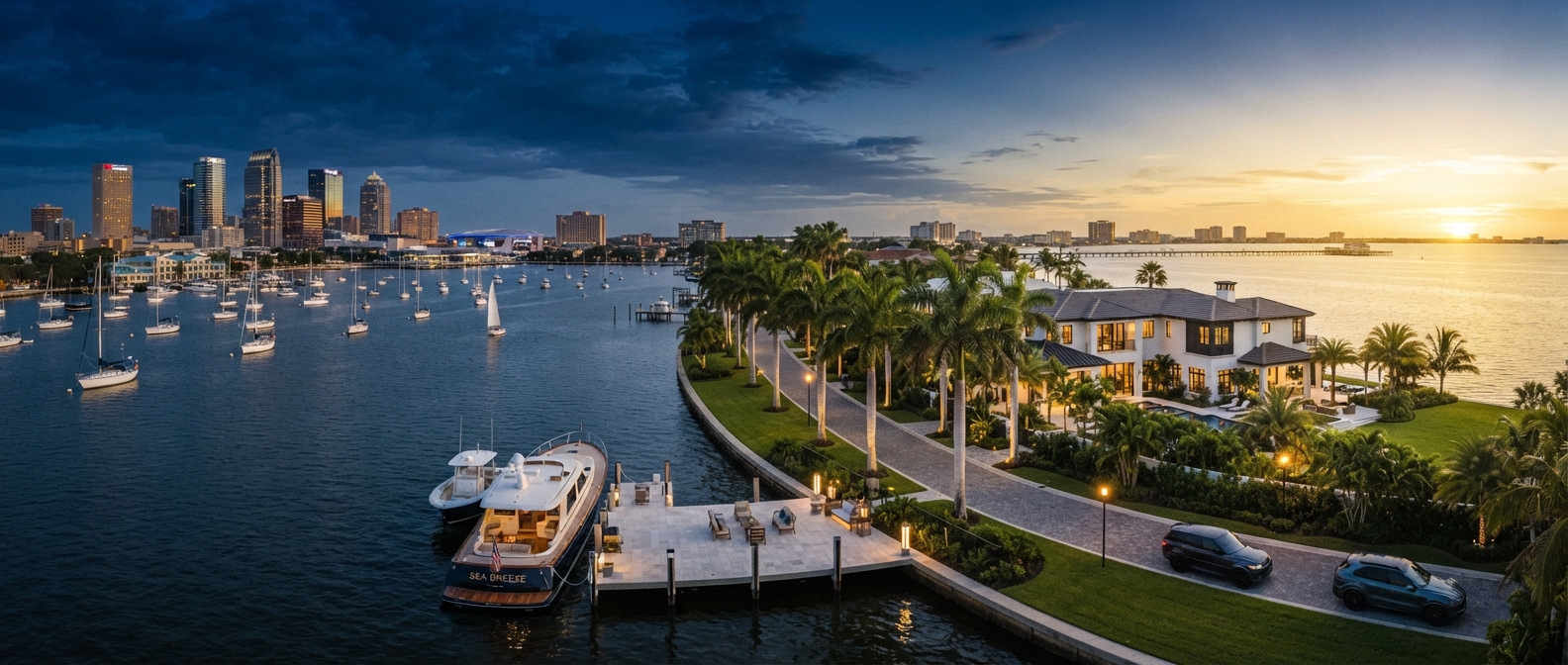
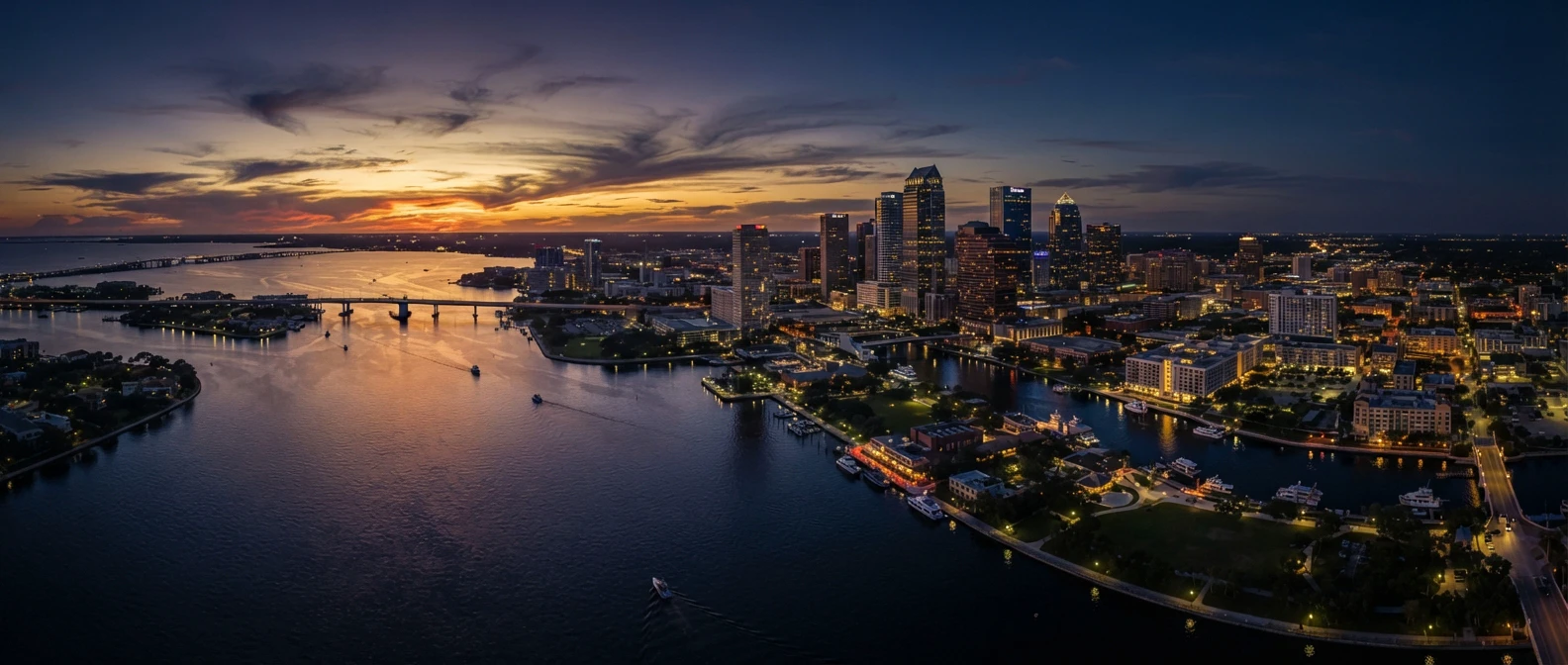
Editorial composite of Tampa Bay luxury living across downtown skyline, St. Petersburg waterfront, and a palm-lined residential corridor at golden hour
Tampa Bay · Buyer's Hub 2026

Tampa Bay luxury buyer: FAQ & decision hub.

The questions every luxury buyer asks first, grouped the way the decision actually runs — submarket, financing, pre-construction, inspection, insurance, closing — with the answers that move from contract to confidence on a Tampa Bay home.

  • South Tampa
  • Wesley Chapel
  • Downtown Tampa
  • St. Petersburg
  • Clearwater Beach
  • Tierra Verde
  • Davis Islands
  • Hyde Park
  • Westchase
  • Channelside
  • South Tampa
  • Wesley Chapel
  • Downtown Tampa
  • St. Petersburg
  • Clearwater Beach
  • Tierra Verde
  • Davis Islands
  • Hyde Park
  • Westchase
  • Channelside
Quick Facts

What you're deciding.

Six quick reads on the North Star of the 2026 luxury buyer decision in Tampa Bay — the way the search actually sequences from interview to keys.

Focus
Tampa Bay luxury purchase
Decision order
Submarket → property → offer
Buyer posture
Narrative-led, not tour-led
Pre-construction window
24–36 months to keys
Top exposure
Insurance + assessment stack
Closing reading
Estoppel + master policy
What you actually decide

Three calls before the first tour.

Jump to the FAQ →
Decision · 01

Which submarket fits the life.

Tampa, St. Pete, Clearwater Beach, Wesley Chapel, Tierra Verde — each one trades water view for commute, walkability for square footage, and new construction for resale composition. The buyer who picks the submarket first compresses every later decision. The buyer who picks the house first usually re-picks the submarket three years later.

Decision · 02

New construction vs resale.

Pre-construction allocates you a floor and a release price, but it shifts risk onto the buyer for cost escalations, amenity cuts, and delivery delay. Resale is opaque on the interior but settled on the carry-cost, the HOA trajectory, and the immediate exit math. The right move depends on whether you want pricing leverage or deliverable leverage.

Decision · 03

Trophy asset vs compound.

A trophy penthouse in a downtown tower carries amenity, view, and exit-floor liquidity. A waterfront compound carries land, dockage, privacy, and a longer resale curve. The trophy buyer optimizes for status and short-cycle exit. The compound buyer optimizes for legacy, multi-generational use, and build-out of adjacent parcels.

FAQ · Six clusters

The questions a luxury buyer asks first.

Six clusters, twenty-eight answers. The themes behind every first consult, in the order the decision actually runs.

Cluster · 01Submarket decision

The most expensive decision in any Tampa Bay purchase is the submarket, decided first. These are the questions buyers bring to that decision before they ever tour a home.

Which submarket leads for a waterfront lifestyle?
Tierra Verde, Davis Islands, and the St. Pete waterfront corridor lead for deep-water dockage and Gulf access. Clearwater Beach leads for sand-on-property. South Tampa and Hyde Park lead for in-city water view without the bridge dependency. The decision is whether your priority is dock size, beach footprint, or commute — not which submarket is ‘best.’
Tampa vs St. Pete — how do buyers usually decide?
Most buyers decide on commute first and lifestyle second. Tampa wins for buyers with a downtown Tampa or Westshore work anchor. St. Pete wins for buyers prioritizing walkable waterfront, museum and dining density, and a one-bridge access to the Gulf. Wesley Chapel and the northern I-75 corridor win for buyers prioritizing new construction square footage over water.
Should a relocating buyer start with a submarket or a property type?
Start with the submarket. Once the submarket is set, the property type follows: downtown submarkets push toward condo and townhome, inland suburban submarkets push toward single-family and compound. Reversing the order causes redundant tours and forces the submarket choice after the emotional weight of a specific house has settled in.
Is Wesley Chapel still a luxury submarket?
Yes, but on different terms. Wesley Chapel is luxury by square footage, lot size, and new-construction amenity package — not by water. Two Rivers is the clearest example: gated, amenitized, 1-acre+ estate lots on the regional scale. The Wesley Chapel buyer trades water access for new-construction quality of life and Hillsborough tax simplicity.
How do school zones enter the submarket decision?
Every Pinellas and Hillsborough submarket carries a different school-zone story. Plant High, Berkeley Prep, St. Pete Gibbs, Palm Harbor University, and Mitchell feed most luxury submarkets, but the zone boundary is what locks the choice, not the school reputation. Confirm the parcel, not the listing address, before contract.
Cluster · 02Financing readiness

Financing readiness in the luxury segment is not a question of approval. It is a question of speed, structure, and how the loan interacts with the seller's preferred close.

Does luxury Tampa Bay pricing require a jumbo loan?
Above the conforming loan limit — currently $766,550 for a single-family in the Tampa Bay MSA — most luxury purchases move to jumbo or portfolio products. Junipers, Bayshore, and the downtown tower stock above $1.5M usually require a portfolio program with one of the regional private banks, not the national jumbos.
Cash vs financed — does it change offer strategy?
Yes, materially. Cash closes in 14–21 days and usually wins over a financed offer of the same price. Financed at 70–75% LTV with a 30-day close usually wins over cash at materially less price. Sellers rank certainty over headline price almost every time — so the offer posture should match the finacing posture rather than fight it.
What documentation should a luxury buyer have ready?
Two years of personal and entity returns, two years of W-2s or K-1s, three months of bank statements for every account that will fund the down payment, a recent investment account snapshot, and — for entity buyers — the operating agreement and a letter of good standing. Have all of it before you tour. Delay on financials is the most common reason luxury offers lose to lower-priced competitors.
Can a luxury buyer use an entity or trust?
Yes, but with friction. Florida title companies will close to an LLC or trust, but expect an extra week of vesting documentation, an additional insured on the title policy, and HOA estoppel language requiring individual identification for voting and rental rights. Most buyers close in personal name and transfer into a holding entity post-close to keep the seller-side optics clean.
Is rate buydown worth it on a luxury hold?
Rarely. Luxury buyers typically hold long enough that the cumulative buydown cost outweighs the rate savings within two years. A permanent buydown is worth negotiating only when the seller is offering credits and the carry-cost differential is the deciding margin. Otherwise, accept the market rate and reserve capital for assessment and renovation.
Cluster · 03Pre-construction timing

Pre-construction in downtown Tampa and along the Bay is a different underwriting exercise. The home does not exist yet; the buyer is underwriting the developer, the release schedule, and the contract.

When does a buyer get the best pre-construction pricing?
Pricing is best at the initial release before the public sales gallery opens. After that, each subsequent release stacks 2–5% above the prior release until construction mid-point, when remaining inventory prices to current comp rather than to the original release schedule. Buyers who miss the initial release typically wait for a release pause or a slow-quarter reset.
What is a pre-construction ‘allocation’?
An allocation is a no-cost reservation that locks your position in the release order without committing to a unit. The developer holds the position for 7–14 days while the buyer reviews the contract, HOA documents, and finishes selection. Allocations are the correct tool for buyers who want position without commitment — but they are not free if you walk.
What contract terms matter most in pre-construction?
Deposit escalation schedule, the developer’s right to substitute materials, the amenity exclusion clause, the assignment right, and the closing-cost cap if applicable. The deposit schedule locks capital for the construction period — typically 18–30 months — and the assignment right determines whether you can exit before closing.
Can a pre-construction buyer assign the contract?
Yes on most Tampa Bay projects, with developer consent and a transfer fee (typically 1–2% of contract price). The assignment right is what makes pre-construction a liquid position: if your life changes or the comps move against you, you can sell the contract mid-construction rather than close on a unit you no longer want.
How long does a pre-construction close actually take?
From contract to keys for a downtown Tampa tower, 24–36 months is the realistic window, with most projects delivering in the 28–32 month band. Construction mid-point is when remaining units price to the current market rather than to the release. Plan capital accordingly and do not over-leverage on what the contract allows.
Cluster · 04Inspection strategy

The luxury inspection window is wider than the standard residential window and includes building-level, mechanical, and environmental reviews that regular inspectors are not licensed to perform.

What inspections are required for a luxury home in Tampa Bay?
General home, WDO (termite), wind mitigation (4-point), roof condition, and an environmental screening for waterfront parcels (mold and sediment). For downtown units, swap WDO for the building-level estoppel package and pull a condo-specific attorney review. For compounds, add a dock and seawall inspection, which most residential inspectors are not qualified to perform.
How does the inspection contingency differ for luxury?
Luxury contracts frequently shorten or waive inspection contingency when the buyer is buying at or above comp. Cash buyers often waive for close certainty; financed buyers usually retain a 10–14 day inspection window even at premium pricing. The decision is a function of pricing leverage, not contract template.
Who pays for the inspection — buyer or seller?
Always the buyer, and the inspection window is the buyer’s right, not the seller’s courtesy. The seller’s contribution is credits at closing, not pre-paid inspections. Treat the inspection as a buyer-side underwriting tool that costs $1,500–$4,500 and protects a multi-million-dollar position.
What is the most-often skipped inspection for waterfront homes?
The dock and seawall inspection. Most residential inspectors will climb onto a dock and flag visible rot but cannot evaluate the seawall cap, the underlying tie-back system, or the neighbor-encroachment easement. A specialist seawall inspector costs $600–$1,200 and saves tens of thousands of dollars on a failing structure that is sold ‘as-inspected.’
Cluster · 05Insurance realities

Tampa Bay carries the highest concentration of insurance friction in the state. The buyer who prices insurance into the offer is the buyer who holds the home for a decade. The buyer who prices on comp alone often re-prices at the first renewal.

Why is luxury insurance in Tampa Bay difficult?
Carrier withdrawal in coastal Florida, named-storm volatility, and aging housing stock along the older water corridors have pushed premiums above national averages. Surface-level renewal quotes can be 50–150% above what the seller is paying. Order your own quote before contract, never assume the seller's premium is your premium.
How much does wind + flood insurance cost on a luxury waterfront home?
Wide range by elevation, construction class, distance to coast, and mitigation credits. A typical luxury waterfront policy stack (HO-3 + wind + flood) can run from $18,000 to $60,000+ annually on the home itself, with the variance set by the seawall elevation and the mitigation credits on the structure. Get a written Florida admitted carrier quote before signing.
What mitigation credits reduce wind premium?
Impact glass throughout, strap-and-shutter certification, hip roof geometry, secondary water barrier, and a verifiable roof-to-wall attachment clip schedule. Each credit moves the premium meaningfully, and the credits are controllable at the inspection window — verify them on every tour, because they compound at every renewal.
How does condo insurance differ from single-family?
In a downtown tower, the HOA master policy covers the building envelope — structure, common areas, exterior walls — but typically excludes interior finishes, personal property, and the unit improvements you added at closing. Your HO-3 covers the interior, and a separate wind and flood policy covers the catastrophic layer even though the master sits over you. Verify the master deductible; a $25,000 deductible flows to owners as an assessment after a single named storm.
Is insurance quote-shock a deal-killer?
Sometimes, and that is the point. Buyers who do not price insurance before contract regularly re-price their offer after the quote arrives, then lose the property or the seller’s willingness to renegotiate. Get the quote, then bid. The insurance quote is part of the offer just like the inspection report is part of the offer.

Cluster · 06Closing mechanics

Luxury closings in Tampa Bay run a 30–45 day clock for financed deals and a 14–21 day clock for cash. The buyer who treats closing as a logistics step leaves money on the table; the buyer who treats it as an underwriting step protects it.

What does a luxury closing timeline actually look like?
Day 0 contract, day 1–7 inspection and appraisal scheduling, day 7–14 title commitment, day 14–21 financing clear-to-close, day 21–30 HOA estoppel and condo doc delivery (if applicable), day 30–45 funded close. Cash buyers compress days 14–21. The HOA estoppel is usually the slowest moving piece in a condo or townhome transaction.
Who picks the closing attorney in Florida?
The buyer, by convention. The seller pays the owner’s title insurance premium but the buyer selects and pays the closing attorney. Selection matters — a residential-only attorney may not pressure the HOA estoppel, the special-assessment language, or the developer-side disclosures that a luxury-trained title agent will. Choose a firm that closes $2M+ inventory weekly, not monthly.
What is an HOA estoppel and why does it matter?
The estoppel is the binding representation from the HOA to the buyer on what is owed, what is in process, and what assessments are pending. It locks the seller’s representation at closing — any assessment that has not been disclosed in the estoppel can be challenged post-close. Pull it before the three-day mark and read every line.
What are the closing costs on a luxury Tampa Bay purchase?
Roughly 2.0–3.5% of the purchase price for a single-family cash deal; 2.5–4.0% on a financed deal with title insurance, lender fees, prepaid taxes, and recording. Documentary stamp tax on the deed is $0.70 per $100 of consideration in Hillsborough and Pinellas; intangible tax on the mortgage is $0.35 per $100. These line items are not estimates — they are statutory and verifiable.
Can closing happen remotely in Florida luxury?
Yes. Florida allows remote online notarization (RON) for deeds and mortgage documents, which means cash and financed buyers can close from anywhere with proper ID. The closing attorney supplies the RON link, runs the funding on the wire instructions, and ships the original documents to the county for recording the next business day.
What a good agent does here

Sourcing, sequencing, and underwriting.

Sourcing

Off-market access that actually closes.

A good agent brings listings that are not on the open market — pocket inventory from local luxury offices, lifetime relationships with private wealth advisors, and SERHANT. network reach. The off-market call is not a database lookup; it is a placement of your buyer narrative with the listing principal before the listing is publicly announced.

Sequencing

Narrative-led, not tour-led.

Buyers who tour first negotiate last. A good agent sequences the search around a written buyer narrative — one page, ten lines, used to qualify listings, building fit, and counterparty alignment before the first showing. Tours become confirmation rather than discovery, and offer strategy becomes precise rather than reactive.

Underwriting

Comparison underwriting on every shortlist.

A good agent underwrites each shortlisted property on the same line items: carry cost over a five-year hold, projected resale envelope, comparison unit within the building, insurance and HOA trajectory, and the assessment exposure. The result is a written comparison memo, not a gut ranking, so the buyer chooses on margin rather than on the most recent tour.

The buyer side of a luxury transaction is decided by the quality of the questions, not the count of the tours. The agent's job is to keep you in the underwriting seat from the first search to the closing table — and to make sure no decision is signed before its reading is complete.

Buyer's Strategy Call

Walk the decision hub with Rob.

Robert O'Connor and Patriot Home Group by SERHANT. represent luxury buyers across Tampa Bay — downtown tower inventory, waterfront compounds, pre-construction allocations, and the off-market pocket listings that never reach the public sites. A 30-minute consult covers carry cost, building health, insurance reality, and the offer posture you haven't been shown yet.

robert.oconnor@serhant.comFounding Member · SERHANT. Florida