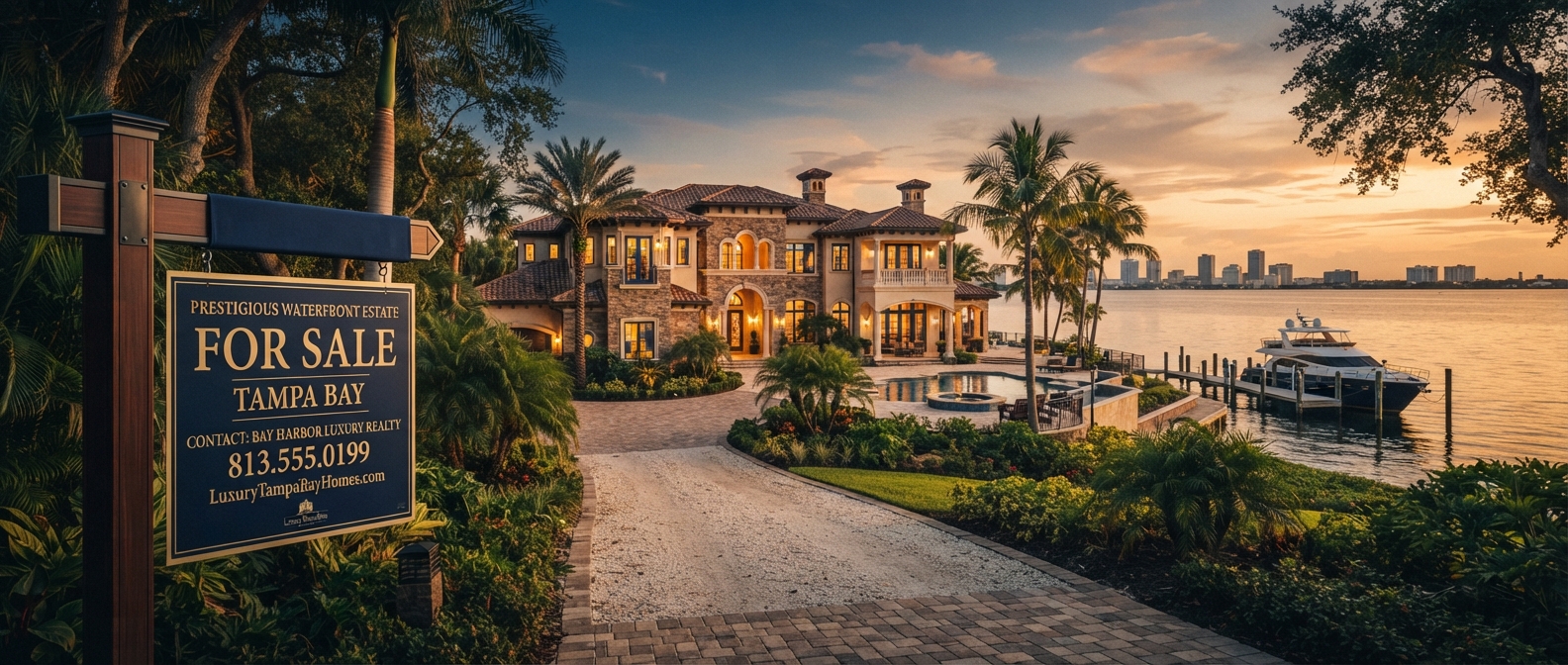
Editorial cinematic view of a Tampa Bay luxury estate at golden hour with the For Sale detail in the foreground, navy and gold tones
Tampa Bay · Seller's Hub 2026

Seller proof, FAQ, and launch signals.

A long-form editorial FAQ for Tampa Bay luxury sellers — the five questions every seller asks first, the five launch signals that tell you whether to hold price or pivot it, and what a sold-over-ask outcome actually requires. Built from the launch methodology I run on every Tampa Bay luxury listing.

  • South Tampa
  • Wesley Chapel
  • Downtown Tampa
  • St. Petersburg
  • Clearwater Beach
  • Tierra Verde
  • Davis Islands
  • Hyde Park
  • Westchase
  • Channelside
  • South Tampa
  • Wesley Chapel
  • Downtown Tampa
  • St. Petersburg
  • Clearwater Beach
  • Tierra Verde
  • Davis Islands
  • Hyde Park
  • Westchase
  • Channelside
What sellers want to know first

The first five questions, answered before Day 1.

These are the five questions Tampa Bay luxury sellers ask most consistently before they sign a listing agreement. The answers below are the working document — not the marketing document — for the launch sequence that follows.

Timing

When to list.

Tampa Bay luxury demand clusters around late February through early May, with a quieter but serious buyer pool between September and November. The wrong month to list is the month you feel the listing pressure, not the month the buyer pool is responding.

Price test

What price to test.

Test the price that should drive 30+ showings in the first 14 days, not the price that feels comfortable. If the absorption target is not met, the move is narrative adjustment — not absorption reset — until Day 21, when re-pricing has its real lever.

Media narrative

How narrative lands.

Luxury narrative is a single positioning sentence the entire campaign returns to — not a feature count. If buyers retain the lifestyle pitch after a single read, the media works; if they retain the bedroom count, the media has underperformed.

Offer architecture

What an offer looks like.

A qualified Tampa Bay offer arrives with proof of funds, a 21-day inspection posture, an appraisal-gap stance, and a closing window tied to buyer's liquidity — not buyer's optimism. Everything else is correspondence, not negotiation.

Day 30 pivot

What if no offers in 30 days.

A soft 30-day window is a signal, not a verdict. The reset is sequential — re-narrate first, re-shoot second, re-price third, in that order, with each step measured against the absorption target before the next lever moves.

Launch signals we monitor

Five clusters, read against Day 14.

The Day 14 launch report reads across five clusters of signal. Each cluster is tracked independently, and the combination of clusters tells you whether to hold price, soften price, or pivot the entire launch strategy before week three.

Written interest.

Pre-emptive emails, agent-to-agent phone calls, and serious written inquiries before the first broker open. This is the earliest sign that the database outreach is converting — and the cluster that tells you whether the price-to-perception line is set correctly.

Tour density.

The number of qualified, agent-led showings in the first ten days, weighted by buyer pool credibility. Density above 35 appointments signals a healthy launch; below 20 means the message is not penetrating past the broker alerts.

Save and share rates.

Listing saves, listing shares, and listing-to-detail click-through on Zillow, Realtor.com, Homes.com, and Instagram. A save rate above 25 per 1,000 views signals that the media and headline are anchoring — below that, the headline is the soft spot.

Agent-to-agent feedback.

What other luxury agents in Tampa Bay say when they walk the home with a buyer. If the buyer-agents are aligned around one of three messages — pricing, layout, or condition — that message is the document of record for Day 11 adjustments.

Off-market inbound.

Direct buyer inquiries, executive relocation desks, and private-network inquiries that arrive without syndication exposure. Off-market inbound is the cleanest read on pricing power — because it strips out the marketing surface entirely.

Pricing outcomes

What “sold over ask” actually requires.

Sold over ask is not the same as sold fast. Tampa Bay buyers will pay a premium over ask when three inputs align at once: scarcity (no comparable inventory in the price band), presentation (the home is photograph-ready on the second tour, not the first), and a buyer whose motivation is relocation, fractional reset, or 1031 timing — not price discovery.

The structure that makes sold-over-ask a defensible outcome is the offer-review cutoff. When qualified offers share a single review window, the best two or three stack into a clean comparison and the negotiation loses the awkwardness of sequential counters. The Tampa Bay luxury homes that close above ask almost always closed through a documented cutoff date.

A sold-over-ask outcome is more closely correlated with discipline than ambition. Sellers who hold the narrative for the first ten days, then review offers in a windowed cadence on Day 12, almost always outperform sellers who review offers as they arrive. The bias toward patience — documented, calendared, and communicated — is the lever most sellers leave on the table.

Run the launch, read the signals

Book your Tampa Bay seller FAQ review.

A 45-minute seller consult to walk through the five questions, the five signal clusters, and the sold-over-ask architecture — applied to the specific home you are listing, the price band you are testing, and the absorption target the Tampa Bay buyer pool is most likely to meet.