
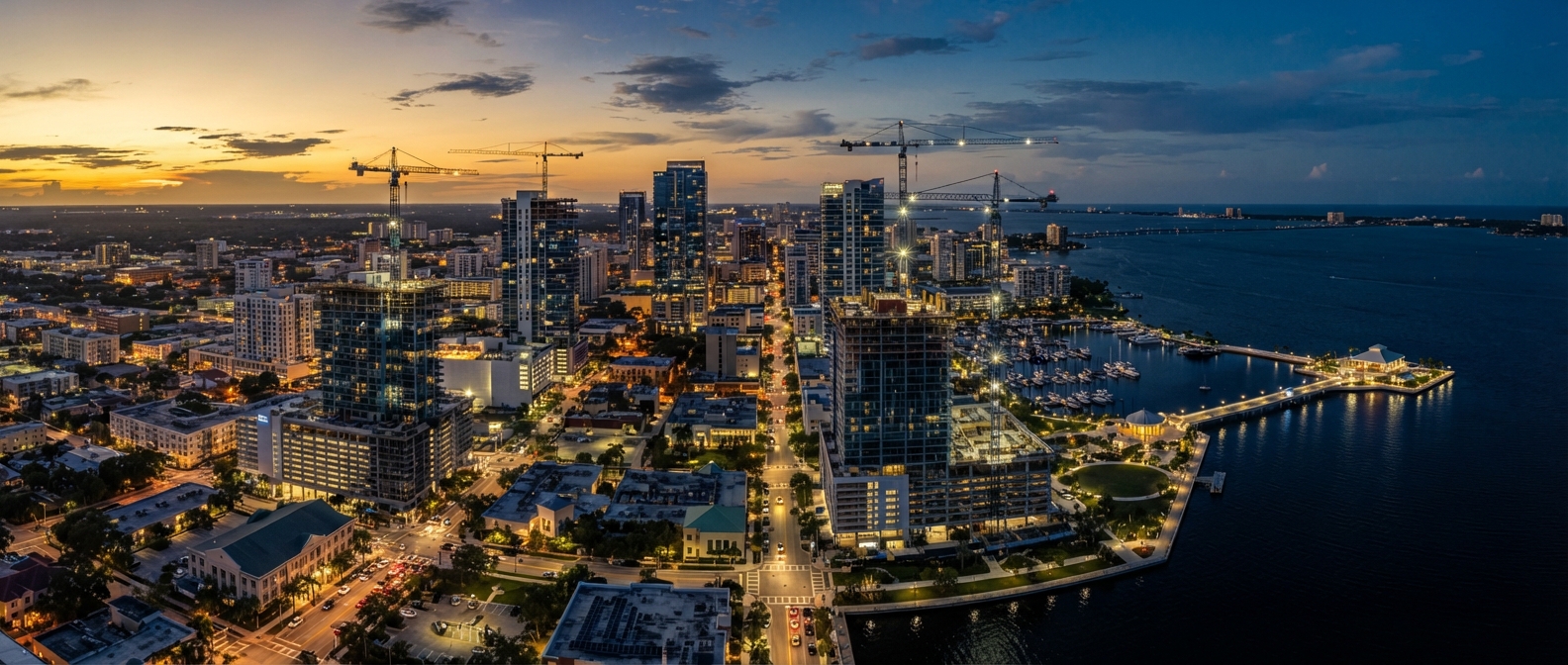
Editorial cinematic aerial of downtown St. Petersburg Florida at blue hour, multiple construction cranes around modern towers, navy water and warm gold sky
Tampa Bay · St. Petersburg Pipeline

St. Pete development projects, 2026.

An editorial map of the 2026 St. Petersburg development pipeline — Roche Bobois Residences, 400 Central, the Mirasol revival, 800 Central, and the Historic Gas Plant District at Tropicana Field — with the buyer-side and seller-side math that each project actually changes.

  • South Tampa
  • Wesley Chapel
  • Downtown Tampa
  • St. Petersburg
  • Clearwater Beach
  • Tierra Verde
  • Davis Islands
  • Hyde Park
  • Westchase
  • Channelside
  • South Tampa
  • Wesley Chapel
  • Downtown Tampa
  • St. Petersburg
  • Clearwater Beach
  • Tierra Verde
  • Davis Islands
  • Hyde Park
  • Westchase
  • Channelside
Major projects in pipeline
5+ · Pinellas core
Total pipeline units
~ 3,400 residential
Completion window
2026 – 2029
Multi-family vs mixed-use
≈ 60% / 40%
Ownership vs rental split
≈ 35% / 65%
Featured submarket
Downtown · EDGE · Pier
The 2026 pipeline, project by project

Five projects,
five underwriting briefs.

The 2026 St. Petersburg pipeline is not a single project and not a single cadence. It is a layered set of deliveries — pre-construction, topping out, adaptive reuse, infill, and district-scale master plan — that price, lease up, and resell on five different timetables. The brief below maps each major project to its submarket, status, unit count, target completion, and the buyer- or seller-side math that the project actually changes.

Designer-Branded Tower · Pre-Construction

Roche Bobois Residences.

Submarket

Downtown · 4th St S

Status

Pre-construction · allocations open

Units

Branded residences, design-furnished

Target completion

Estimated 2029

Roche Bobois Residences at 344 4th St S is St. Petersburg's first designer-branded residential tower — a French-Maison collaboration between Valor Real Estate Development, Gómez Vázquez International, Niz + Chauvet, and Roche Bobois Paris. Every shared surface, from the lobby to the amenity floor, is curated and furnished by the Maison itself, which makes this the most identity-led residential product in the current St. Pete pipeline.

For the 2026 buyer, the tower functions as the walkable half of the St. Pete lifestyle brief — pier-adjacent, museum-adjacent, dining-corridor-adjacent — and trades the bay-front lot at Snell Isle for a designer-branded amenity floor and a downtown address that does not require a car. Allocations move quickly at pre-construction pricing, and priority list terms are run directly through SERHANT. Florida.
Roche Bobois Residences — full brief
Skyline-Anchor · Mixed-Use Vertical

400 Central.

Submarket

Downtown · Central Ave

Status

Under construction · topping-out phase

Units

~ 301 condominiums + retail

Target completion

Anticipated 2026 – 2027

400 Central is the current and future tallest residential tower on Florida's Gulf Coast — a ~41-story mixed-use vertical that combines ~301 condominiums, ground-floor retail, and structured parking into one of the most quietly consequential projects on the entire 2026 St. Pete skyline. The address, the height, and the unit mix have made 400 Central the reference point that the rest of the downtown pipeline is being measured against.

The buyer math on 400 Central is a different exercise than a Snell Isle lot or a Tierra Verde Gulf estate. You underwrite on amenity floor, association reserve, floor plate, view corridor, and the resale depth of the building itself — not on seawall, elevation certificate, and wind premiums. The right 400 Central buyer has already pulled the most recent HOA budget, the assessment history, and the developer's warranty terms before the first showing.

Pier-Adjacent · Adaptive Reuse

The Mirasol Revival.

Submarket

Downtown · Pier District

Status

Adaptive reuse · early planning

Units

Boutique residential + hospitality

Target completion

Concept phase · 2027+ delivery target

The Mirasol revival is the most quietly anticipated adaptive-reuse project on the St. Pete Pier corridor — a redevelopment of an underused, pier-adjacent parcel into a boutique residential and hospitality program that the city has been signalling for two cycles. Where the bigger towers play in scale and amenity floor, the Mirasol revival plays in pier-adjacency, low-rise cadence, and the kind of identity-led programming that fits a Vanderbilt-boulevard evening better than a downtown high-rise.

For a 2026 buyer, the Mirasol revival is the project to track rather than the project to buy today. The concept phase will translate into an inventory package in 2027, the pre-construction cadence will translate into an allocation list in 2028, and the delivery will translate into a resale comp that anchors everything else within a two-block radius. Buyers who get on the early list for the Mirasol revival are buying optionality, not closing on a residence this year.

Central Avenue · Mixed-Use Infill

800 Central.

Submarket

Downtown · Central Ave

Status

Under construction · early vertical

Units

~ 210 multi-family + ground retail

Target completion

Targeting 2027

800 Central is the Central Avenue mixed-use infill project that retailers, residential renters, and downtown office tenants have been quietly awaiting since the corridor's first wave of infill deliveries. The project combines ~210 multi-family units with structured parking and a meaningful ground-floor retail program that supports the dining-and-walkable cadence the 800 block has been missing for a decade.

For an investor or a long-horizon buyer tracking the rental side of the 2026 St. Pete pipeline, 800 Central is the project that decides the rental absorption conversation for the eastern half of Central Avenue. The right 800 Central buyer underwrites on lease-up cadence, the retail anchor lineup, and the long-term hold math — not on finishes in the model unit, which is the trap first-time downtown investors fall into with mixed-use infill.

Historic Gas Plant District · District-Scale

Tropicana Field District.

Submarket

South St. Pete · 86-acre district

Status

District master plan · phased delivery

Units

Thousands of units + civic + retail

Target completion

Phased · 2027 – 2030s

The Tropicana Field district — the Historic Gas Plant District redevelopment — is the largest, longest-cadence project on the 2026 St. Petersburg pipeline. An approximately 86-acre district-scale master plan that combines residential neighborhoods, cultural venues, commercial programs, and public infrastructure into a single phased delivery. This is the project that will decide what south St. Pete prices and rents at in the second half of the decade.

For the 2026 buyer or seller, the Tropicana Field district is not a closing-this-year decision; it is a positioning decision. South St. Pete sellers within a one- to three-mile influence radius of the master plan should be mapping their list narrative to the district upgrade today, not after vertical construction is visible from the front porch. Buyers with a three- to five-year horizon should be tracking the early parcel releases before the corridor shows up in the next Tampa Bay market report headline.

Pipeline at a glance

One table,
five deliveries.

The 2026 St. Petersburg pipeline at a glance — project, submarket, status, unit count, and target completion. Use it as a tracker, not a closing checklist.

ProjectSubmarketStatusUnitsTarget completion
Roche Bobois ResidencesDowntown · 4th St SPre-constructionBranded residencesEst. 2029
400 CentralDowntown · Central AveUnder construction~ 301 condos + retail2026 – 2027
Mirasol RevivalPier DistrictAdaptive reuse · planningBoutique resi + hospitalityTarget 2027+
800 CentralDowntown · Central AveUnder construction~ 210 multi-familyTarget 2027
Tropicana Field DistrictSouth St. Pete · 86 acMaster plan · phasedThousands · mixed-use2027 – 2030s

Pipeline figures reflect publicly available developer materials, current phase filings, and active broker pre-construction packages as of Q1 2026. All dates are subject to change.

What this means for buyers

Pipeline timing,
not headline pricing.

The 2026 St. Petersburg pipeline is read correctly as a buyer-side positioning map, not as a buyer's market. Every project on the table changes the question a buyer should be asking in 2026.

The 2026 St. Petersburg pipeline reads as a buyer's map of opportunity, not a buyer's market. The question is not whether supply is arriving — it is, in waves from 2026 through 2029 — it is which slot in the pipeline a buyer is actually buying. The owner-occupant buyer mapping to the Snell Isle or Tierra Verde waterfront map is buying something the pipeline does not produce: open-air bay and Gulf real estate with a dock, an elevation certificate, and a seawall permit history. The pipeline does not replace that product; it sits beside it.

The buyer who should be paying the closest attention to the 2026 pipeline is the one considering a pre-construction allocation. Roche Bobois Residences, the Mirasol revival on the early list, and the early parcel releases inside the Tropicana Field district are all candidates for pre-construction pricing, and the buyers who clear pre-construction with confidence have already locked the developer warranty, the projected assessment cadence, and the resale comp math before they write. The buyers who skip that prep are buying the model unit finish, not the building.

For the 2026 buyer with a three- to five-year horizon, the pipeline timing matters more than the headline pricing. A unit closing in 2027 carries into a delivery year where the next-door project may still be under construction; a unit closing in 2029 carries into a delivery year where the corridor is fully built out. The pipeline does not change what you buy; it changes what you own by the time the building reaches stabilization.

What this means for sellers

Position to the corridor,
not the headline.

The 2026 pipeline is a seller-side positioning asset when the listing narrative is anchored to the upgrades a buyer will actually live next to. The wrong seller this year is the one who waits for vertical construction before re-listing.

For 2026 sellers in St. Petersburg, the pipeline is a positioning asset, not a pricing asset. The Tropicana Field district master plan, the 400 Central topping-out, the 800 Central lease-up, and the Roche Bobois Residences pre-construction cadence all strengthen buyer confidence within an influence radius of one to three miles — but only if the listing narrative is anchored to the upgrades that the buyer will actually live next to, not to the headline square footage of the project.

The seller who maps the wrong way to the pipeline is the one who lists as if their home were the headline project. Buyers in 2026 are sharper than that. They are pulling developer warranties, HOA reserves, association budgets, and the unit-mix of nearby competing projects before they tour. The seller who clears with confidence in this market has already pulled a comp set that places their property within the corridor conversation, not above it.

The seller who benefits the most from the 2026 pipeline is the one with a three- to twelve-month delivery window. The current pipeline is the strongest the city has ever carried, and the absorption math for 2026 — especially in the south St. Pete influence radius of the Tropicana Field district — is favorable for sellers who price to the upgraded comp set rather than to the legacy comp set. The wrong seller this year is the one who waits for the project to break ground before they re-list.

Frequently asked

Pipeline,
before the offer.

The questions St. Petersburg buyers and sellers most often ask after the pipeline map — answered before we set up the due-diligence calendar.

Which St. Petersburg development project should a luxury buyer be tracking first in 2026?

Roche Bobois Residences and 400 Central are the two most consequential projects on the 2026 St. Petersburg pipeline for the luxury buyer. Roche Bobois Residences opens a designer-branded pre-construction allocation list that no other project on the pipeline can replicate, and 400 Central tops out as the tallest residential tower on Florida's Gulf Coast. Buyers who treat the pipeline as a positioning map — and not a closing-this-year checklist — should put Roche Bobois Residences and 400 Central at the top of the tracker this quarter.

How does the 2026 St. Pete pipeline interact with the waterfront map?

The pipeline and the waterfront map do not compete; they sit beside each other. The pipeline produces owner-occupied residential, branded residence, and multi-family rental product — none of which replaces the open-air bay-front lot at Snell Isle or the Gulf deep-water estate at Tierra Verde. A meaningful share of my 2026 pipeline buyers are pairing a downtown allocation with a waterfront purchase, which is the pair that defines the full St. Petersburg lifestyle brief rather than half of it.

When should a south St. Pete seller re-list to capture the Tropicana Field district master plan?

The Tropicana Field district influence radius is strongest for sellers who re-list on the early parcel releases, not on the vertical construction phase. A property within one to three miles of the master plan should be anchored to the district upgrade before the corridor shows up in the next market report headline, which is the window where the listing narrative still reads as fresh. Sellers who wait for vertical construction lose the early-positioning premium.

St. Pete pipeline consult

Send me the project.
I'll come back with the timing, the carry, and the comp.

A 30-minute St. Petersburg pipeline consult, one address or one project: the placement within the 2026 delivery cadence, the underwriting math (pre-construction warranty, HOA reserve, lease-up scenario, or seawall-adjacent waterfront carry), and a risk-adjusted timing call before you write. The pipeline map above, run on the specific project you are considering.

robert.oconnor@serhant.comFounding Member · SERHANT. Florida